Baby Clothing Manufacturers: The Ultimate Guide to Starting a Baby Fashion Brand
The global baby apparel market is experiencing remarkable growth, creating exciting opportunities for entrepreneurs and fashion brands looking to enter this thriving industry. With parents increasingly prioritizing quality, safety, and sustainability in their purchasing decisions, the demand for exceptional baby clothing has never been stronger.
According to recent market research, the global baby clothing market reached $67.47 billion in 2024 and is projected to grow to $107.95 billion by 2032, with a steady compound annual growth rate of 6.20%. The Asia-Pacific region dominates the market with a 39.40% share in 2024, driven by rising birth rates and increasing disposable income in China and India. This surge represents a significant opportunity for brands partnering with the right baby clothing manufacturer.
This comprehensive guide will help you understand the baby clothing market and find the perfect manufacturing partner for your baby fashion business.
Table of Contents
- Understanding the Baby Clothing Market
- Types of Baby Clothing Products
- Market Trends Driving Growth
- How to Find a Baby Clothing Manufacturer
- What to Look for in a Manufacturing Partner
- Starting Your Baby Clothing Brand
- Common Questions About Baby Clothing Manufacturing
Understanding the Baby Clothing Market
The baby clothing industry has evolved far beyond basic onesies and sleepers. Today's market encompasses diverse categories serving different consumer needs, safety requirements, and style preferences—each presenting unique opportunities for brand development.
Market Size and Growth Potential
The baby apparel industry's expansion reflects broader societal changes in parenting and consumer behavior:
- Premiumization Trend: Modern parents willing to spend 30-50% more on high-quality, safe baby clothing
- Safety Consciousness: Increased demand for certified organic and chemical-free baby apparel
- Fashion Forward: Parents extending their personal style to their children's wardrobes
- Social Media Influence: Instagram-worthy baby content driving demand for stylish, photogenic apparel
Regional Market Insights
The Asia-Pacific region dominates the global baby clothing market, valued at $28.52 billion in 2024 and accounting for 39.40% of global revenue. China leads as the second-largest children's population globally with approximately 298 million children (159 million boys, 139 million girls), driving significant demand following the end of its one-child policy.
Key regional highlights:
- China: Expected to reach $11.01 billion by 2025, fueled by policy changes and rising middle-class income
- India: Projected to reach $7.68 billion by 2025, driven by e-commerce expansion (FirstCry, Flipkart)
- United States: Expected to reach $11.1 billion by 2025, with strong demand for premium organic baby clothing
- Europe: Second-largest market expected to reach $18.48 billion by 2025; strong demand for sleepwear and winter clothing due to seasonal climate factors
- UAE: Growing to $468.96 million by 2025, with premium brands like Baby Dior driving high-end demand
North America and Europe maintain strong demand for organic and sustainable baby clothing, while Asia-Pacific shows the fastest growth due to improving retail infrastructure and increasing online penetration.
Types of Baby Clothing Products
Understanding the different categories of baby clothing is essential for defining your brand niche and finding the right baby apparel manufacturer for your specific needs.
Essential Everyday Baby Wear
Everyday baby essentials form the foundation of any baby clothing line:
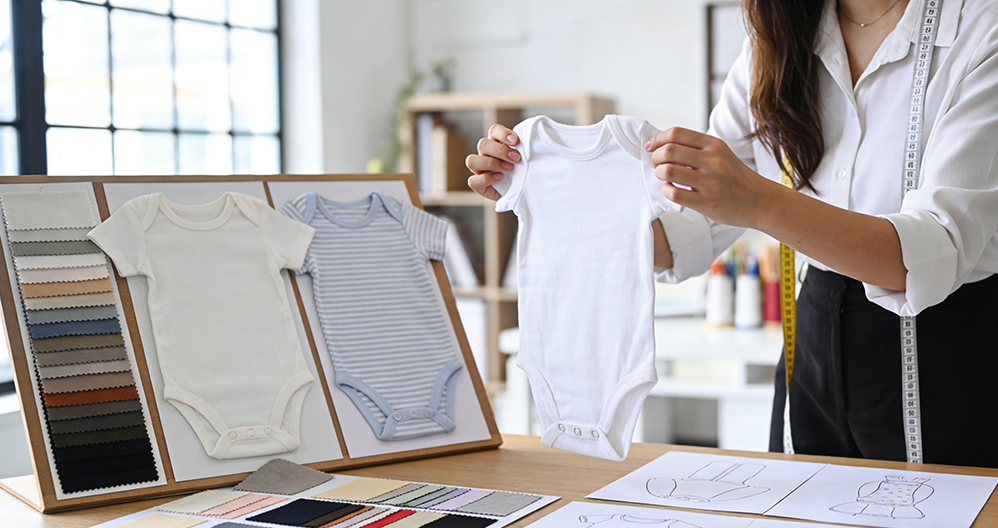
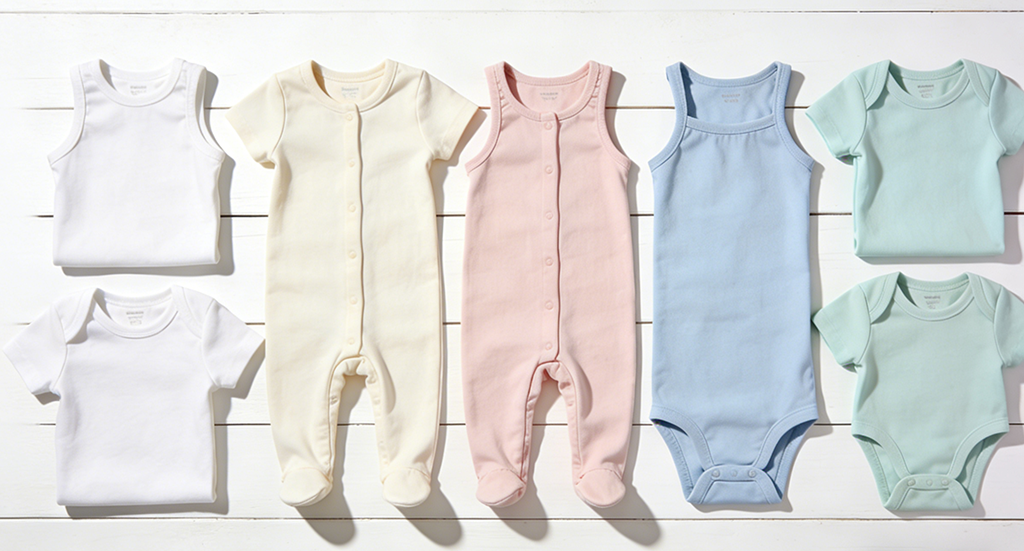
- Onesies and Bodysuits: The most searched-for baby item, available in short sleeve, long sleeve, and sleeveless variants
- Sleepwear and Pajamas: Sleep sacks, zippered sleepers, and traditional two-piece pajama sets
- Rompers and Coveralls: One-piece outfits for easy dressing and comfort
- T-Shirts, Tops, and Bottoms: Separate pieces for mixing and matching
- Hats and Socks: Essential accessories for temperature regulation
Basic onesies and bodysuits represent the highest volume segment, with parents typically purchasing 10-15 pieces per size category. This category offers excellent opportunities for new brands entering the market.
Functional Baby Clothing
Functional baby apparel serves practical purposes and addresses specific parenting needs:
- Swaddle Blankets and Sleep Sacks: Sleepwear designed to mimic the comfort of the womb while meeting safety standards
- Weather Protection: Insulated snowsuits for winter, lightweight sun protection clothing for summer
- Diaper Covers and Bloomers: Protective layers that add style while containing messes
- Bibs and Burp Cloths: Essential accessories that coordinate with clothing collections
Functional baby clothing has seen significant growth as parents seek products that combine safety, convenience, and style. Sleep sacks alone represent a rapidly growing segment as more parents move away from loose blankets for safety reasons.
Special Occasion & Premium Baby Wear
The premium segment serves discerning customers seeking exclusivity and celebration:
- Christening and Baptism Outfits: Traditional and modern ceremonial attire
- Holiday and Seasonal Collections: Halloween costumes, Christmas outfits, Easter ensembles
- Luxury and Designer Baby Clothes: High-end pieces using premium materials like cashmere and silk
- Personalized Baby Clothing: Custom embroidered names, birth details, and unique design elements
This segment commands higher price points (often 3-5x standard pricing) and requires baby clothing manufacturers with specialized capabilities in custom work, premium materials, and attention to detail.
Sustainable & Organic Baby Clothing
The fastest-growing segment in baby apparel focuses on health and environmental consciousness:
- Organic Cotton Baby Clothes: GOTS-certified organic cotton free from pesticides and synthetic fertilizers
- Bamboo Fabric Baby Clothing: Naturally antimicrobial, moisture-wicking, and incredibly soft
- Recycled Material Baby Wear: Apparel made from recycled polyester and other sustainable fibers
- GOTS-Certified Baby Clothing: Products meeting the Global Organic Textile Standard for organic textiles
Research shows that 67% of parents are willing to pay premium prices for organic baby clothing, driven by concerns about chemicals, allergies, and environmental impact. Additionally, approximately 85% of parents consider cotton clothing most comfortable for their children, making it the dominant material choice. This trend has created significant opportunities for brands partnering with certified organic baby clothing manufacturers.
Market Trends Driving Growth
Several key trends are shaping the future of baby clothing and creating opportunities for new brands:
Organic and Sustainable Materials
Eco-conscious parents are driving demand for sustainable baby clothing options:
- Chemical-Free Products: Growing awareness of harmful substances in conventional textiles
- GOTS Certification: Increasing consumer recognition of organic textile standards
- Transparent Supply Chains: Parents demanding visibility into material sourcing and production
- Eco-Friendly Packaging: Minimal, recyclable packaging becoming a brand differentiator
The organic baby clothing market is growing at 6.20% CAGR, with sustainable materials becoming increasingly important to parents. Major brands are promoting sustainable clothing globally, such as PatPat's launch of a baby clothing line made from Naia cellulose fiber in April 2023, featuring over 45 different romper designs.
Premium and Luxury Segment Growth
High-end baby fashion has entered the mainstream with luxury brands expanding their presence:
- Designer Baby Collections: LVMH launched its first baby clothing, shoes, and accessories collection in January 2023 for infants aged 3-12 months; luxury brands including Gucci, Fendi, Dior (Baby Dior), and Bonpoint creating dedicated baby lines
- Market Share: Upper-priced segment commanded 47% market share in 2024, while the premium/luxury segment shows significant growth potential
- Celebrity Influence: High-profile celebrity babies driving trends and demand
- Investment Pieces: Parents viewing premium baby clothing as keepsakes and investments
- Baby Gift Market: Special occasion baby wear as luxury gifts for baby showers and newborns
Smart Baby Clothing and Technology Integration
Innovation is creating new categories in baby clothing with biometric sensor-based products gaining popularity:
- Smart Baby Clothing: Temperature-monitoring fabrics and breathing detection capabilities. For example, Nanit launched baby breathing wear in June 2019, featuring custom patterns readable by connected cameras for parents to monitor breathing movements
- Advanced Material Science: Moisture-wicking, temperature-regulating, and antibacterial fabrics
- Wearable Technology: Smart clothing that can detect various activities and transmit information to parents' smartphones
- Sustainable Production: Manufacturing methods reducing water usage and chemical processing
The integration of technology with baby clothing is expected to stimulate product demand as parents seek innovative solutions for monitoring and comfort.
Gender-Neutral and Minimalist Designs
Modern parenting aesthetics are influencing baby fashion:
- Unisex Baby Clothing: Growing rejection of traditional pink/blue color schemes
- Minimalist Design: Neutral palettes, simple patterns, and timeless styles
- Capsule Collections: Curated mix-and-match wardrobes for practical yet stylish dressing
- Gender-Reveal Trend: Clothing designed to work for any gender until birth
How to Find a Baby Clothing Manufacturer
Finding the right manufacturing partner is crucial for your baby clothing brand's success. Here's how to approach your search:
Industry Trade Shows
Baby and fashion trade shows offer excellent opportunities to meet manufacturers:
- Children's Club NYC – Premier children's fashion trade show in New York, held twice annually
- Kind + Jugend – Leading international baby and toddler products trade show in Cologne, Germany
- CBME China – China Baby Maternity Expo, Asia's largest baby products show in Shanghai
- MAGIC Las Vegas – Major fashion trade show with children's apparel manufacturing connections
- CPMA Expo – Children's Product Manufacturers Association events focused on safety and compliance
Online B2B Platforms
Digital platforms can connect you with baby clothing manufacturers globally:
- Alibaba – Search for "baby clothing manufacturer" or "infant apparel manufacturer" with verified supplier badges
- ThomasNet – North American manufacturing directory for domestic production
- Maker's Row – American manufacturers specializing in various product categories
- Sewport – Fashion-focused manufacturer platform with baby clothing specialists
Specialized Searches
Use targeted search terms to find manufacturers experienced in baby apparel:
- "baby clothing manufacturer [country/region]"
- "organic baby clothing manufacturer OEM"
- "baby apparel manufacturer private label"
- "custom baby clothing manufacturer"
- "baby onesie manufacturer wholesale"
- "sustainable baby clothing manufacturer"
- "GOTS certified baby clothing manufacturer"
- "baby sleepwear manufacturer"
What to Look for in a Manufacturing Partner
Not all apparel manufacturers can successfully produce baby clothing. The unique safety requirements and material standards make this category especially demanding. Here are the key factors to consider:
Safety and Compliance Expertise
Baby clothing is subject to stringent regulations that vary by market:
- CPSC Compliance (USA): Manufacturers must understand Consumer Product Safety Commission requirements
- CPSIA Compliance: Consumer Product Safety Improvement Act standards for lead, phthalates, and testing
- REACH Compliance (EU): European Union chemical regulations for textiles
- Flammability Standards: Particularly strict requirements for children's sleepwear
- ASTM Standards: Voluntary standards that many brands adopt for quality assurance
A qualified baby clothing manufacturer should have established procedures for testing and documentation to meet these requirements.
Material Knowledge and Safety
Baby-safe materials require specialized expertise:
- Hypoallergenic Fabrics: Understanding which materials minimize allergic reactions
- Chemical-Free Processing: Knowledge of dyeing and finishing without harmful substances
- Choking Hazard Prevention: Expertise in secure fastening and avoiding small detachable parts
- Flame Resistance: Understanding when flame-resistant treatments are necessary versus when snug-fitting alternatives are preferred
Production Capabilities
Essential questions to ask potential baby apparel manufacturers:
- What is your minimum order quantity (MOQ) for baby clothing?
- Do you offer sample production before bulk orders?
- Can you work with GOTS-certified organic materials?
- What size ranges do you offer (preemie, newborn, 0-3M, 3-6M, etc.)?
- Do you provide private label or white label baby clothing services?
- Can you accommodate custom labeling and packaging requirements?
Typical MOQs for baby clothing range from 50-300 pieces per style depending on the manufacturer and location, with some specialized manufacturers offering lower quantities for startups.
Quality Control and Certifications
Critical quality considerations for baby clothing:
- Material Certifications: GOTS (organic), OEKO-TEX Standard 100 (harmful substances), OCS (Organic Content Standard)
- Safety Testing: Third-party testing for choking hazards, flammability, and chemical content
- Quality Control Processes: Inspection protocols and defect handling procedures
- Traceability: Ability to track materials through the supply chain
Starting Your Baby Clothing Brand
Define Your Niche
Successful baby clothing brands often start with a focused approach:
- Organic/Natural Baby Clothes: Focus on GOTS-certified organic materials and eco-conscious parents
- Premium/Luxury Baby Wear: Position in the high-end segment with designer-quality pieces
- Budget-Friendly Baby Essentials: Compete on value without compromising safety
- Gender-Neutral Baby Clothing: Modern, minimalist designs that work for any baby
- Special Occasion Baby Outfits: Focus on christening gowns, holiday wear, and celebration pieces
- Functional Baby Wear: Specialize in sleep sacks, swaddles, and problem-solving products
Start Small and Scale
- Begin with a Test Collection: 5-10 essential pieces to test market response
- Focus on Core Products: Start with onesies, sleepers, or rompers—whichever aligns with your niche
- Gather Parent Feedback: Use initial sales and reviews to refine your product offerings
- Build Brand Recognition: Develop a strong social media presence, especially on Instagram and Pinterest
- Expand Gradually: Add new styles, sizes, and categories based on customer demand and sales data
Marketing Strategies for Baby Clothing
- Influencer Partnerships: Collaborate with parenting influencers, mommy bloggers, and family accounts
- User-Generated Content: Encourage customers to share photos of babies wearing your products
- Educational Content: Share information about baby care, safety, sizing, and material benefits
- Lifestyle Photography: Show babies in real-world scenarios wearing and enjoying your clothing
- Email Marketing: Build a subscriber list for product launches and parenting tips
- Baby Registry Integration: Partner with baby registry platforms to reach expectant parents
Common Questions About Baby Clothing Manufacturing
What is the typical MOQ for baby clothing?
Minimum order quantities vary significantly:
- Overseas manufacturers: Often 100-300 pieces per style/color
- Domestic manufacturers: May accept 50-100 pieces for startups
- Specialized baby manufacturers: Some offer lower MOQs (25-50 pieces) for new brands
- No-minimum options: Limited availability, typically at higher per-unit costs (2-3x standard pricing)
When starting out, consider focusing on fewer colors within each style to reduce your overall MOQ commitment while still offering variety.
How much does baby clothing manufacturing cost?
Per-unit costs depend on multiple factors:
- Basic Onesies: $2-$6 per piece (cotton, standard construction)
- Rompers and Coveralls: $3-$8 per piece (more complex construction)
- Sleepwear: $4-$10 per piece (additional safety requirements)
- Premium/Complex Items: $8-$20+ per piece (organic materials, special features, low quantities)
Key cost factors:
- Materials: Organic cotton costs 20-30% more than conventional cotton
- Quantity: Higher volumes reduce per-unit costs by 30-50%
- Origin: Domestic manufacturing costs 2-4x more than overseas production
- Complexity: Additional features (zippers, snaps, embroidery) increase costs
What materials are best for baby clothing?
The best materials balance safety, comfort, and practicality:
- Cotton: The dominant material choice, accounting for the largest market share due to inherent softness. Approximately 85% of parents globally prefer cotton for their children's comfort (Cotton Incorporated & Cotton Council International, 2019)
- Wool: Growing at 5.42% CAGR (2025-2032), especially for cold climate conditions
- Bamboo Fabric: Naturally antimicrobial, moisture-wicking, and incredibly soft against sensitive skin
- Modal: Made from beech wood fibers—luxuriously soft, resistant to shrinking and pilling
- Merino Wool: Temperature-regulating and naturally flame-resistant (ideal for sleepwear)
- Muslin: Lightweight, breathable fabric perfect for swaddle blankets and warm-weather clothing
- Avoid: Synthetic blends for newborns and babies with sensitive skin; flame-retardant chemicals unless necessary
What certifications do baby clothes need?
Certifications vary by market and material claims:
- GOTS (Global Organic Textile Standard): Required for organic textile claims; covers ecological and social criteria
- OEKO-TEX Standard 100: Certifies textiles are free from harmful substances; highly recognized by parents
- CPSIA Compliance: Mandatory for all children's products in the United States
- CPSC Certification: Required for children's sleepwear and products with specific safety considerations
- REACH Compliance: Required for selling in the European Union
- Fair Trade Certified: Optional but increasingly important for brand positioning
Working with a certified organic baby clothing manufacturer can streamline the certification process.
How do I size baby clothing correctly?
Proper sizing is crucial for customer satisfaction:
- Standard Size Ranges: Preemie, Newborn, 0-3M, 3-6M, 6-9M, 9-12M, 12-18M, 18-24M, 2T, 3T, 4T
- Weight Guidelines: Most sizes correspond to weight ranges (e.g., 0-3M typically fits 7-12 lbs)
- Height Considerations: Length measurements help ensure proper fit as babies grow at different rates
- Adjustable Features: Look for manufacturers who incorporate snap closures, elastic waistbands, and adjustable features
- Size Charts: Provide detailed measurement charts for each style to help parents choose correctly
Many brands create their own size charts based on fit preferences, but starting with industry standards provides a reliable foundation.
What regulations apply to baby clothing?
Regulations vary by country but typically include:
- Flammability Standards: Strict requirements for children's sleepwear, especially in the US market
- Choking Hazard Prevention: Restrictions on small buttons, snaps, and decorative elements that could detach
- Lead and Phthalate Restrictions: CPSIA limits in the US; REACH restrictions in the EU
- Labeling Requirements: Origin, care instructions, size, and safety warnings must be clearly labeled
- Tracking Labels: Required for children's products to enable batch identification in case of recalls
- Drawstring Restrictions: Prohibited on children's clothing due to strangulation hazards
A knowledgeable baby clothing manufacturer will understand these requirements and help ensure compliance.
Ready to Launch Your Baby Clothing Brand?
The baby clothing market offers tremendous potential for entrepreneurs with vision and the right manufacturing partnerships. With steady growth projected through 2030 and increasing consumer interest in quality, safety, and sustainability, there's never been a better time to enter this dynamic industry.
Success in baby clothing requires understanding your target customers, prioritizing safety and comfort, and partnering with a baby clothing manufacturer who shares your commitment to quality. With the Asia-Pacific region leading market growth and organic/sustainable materials driving consumer preferences, brands that adapt to these trends will be well-positioned for success. Whether you're focusing on organic essentials, premium luxury pieces, functional sleepwear, or special occasion outfits, the right manufacturing partner makes all the difference.
At HeYou Apparel, we specialize in helping fashion brands and entrepreneurs bring their baby clothing visions to life. Our experienced team understands the unique requirements of baby apparel manufacturing, from safety compliance to material certifications, and is ready to help you navigate every step of the production process.
Contact us today to discuss your baby clothing project and discover how we can help you create a successful brand in this thriving market.